How to Play Indian Rummy
Form sequences and sets — a pure sequence is non-negotiable.
Indian Rummy (Paplu / 13-Card Rummy) is India's most popular card game. Each player receives 13 cards and must arrange them into valid sequences and sets. The golden rule: you must have at least one pure sequence before you can declare.
🎮 Ways to Play Indian Rummy
Create a Indian Rummy Table
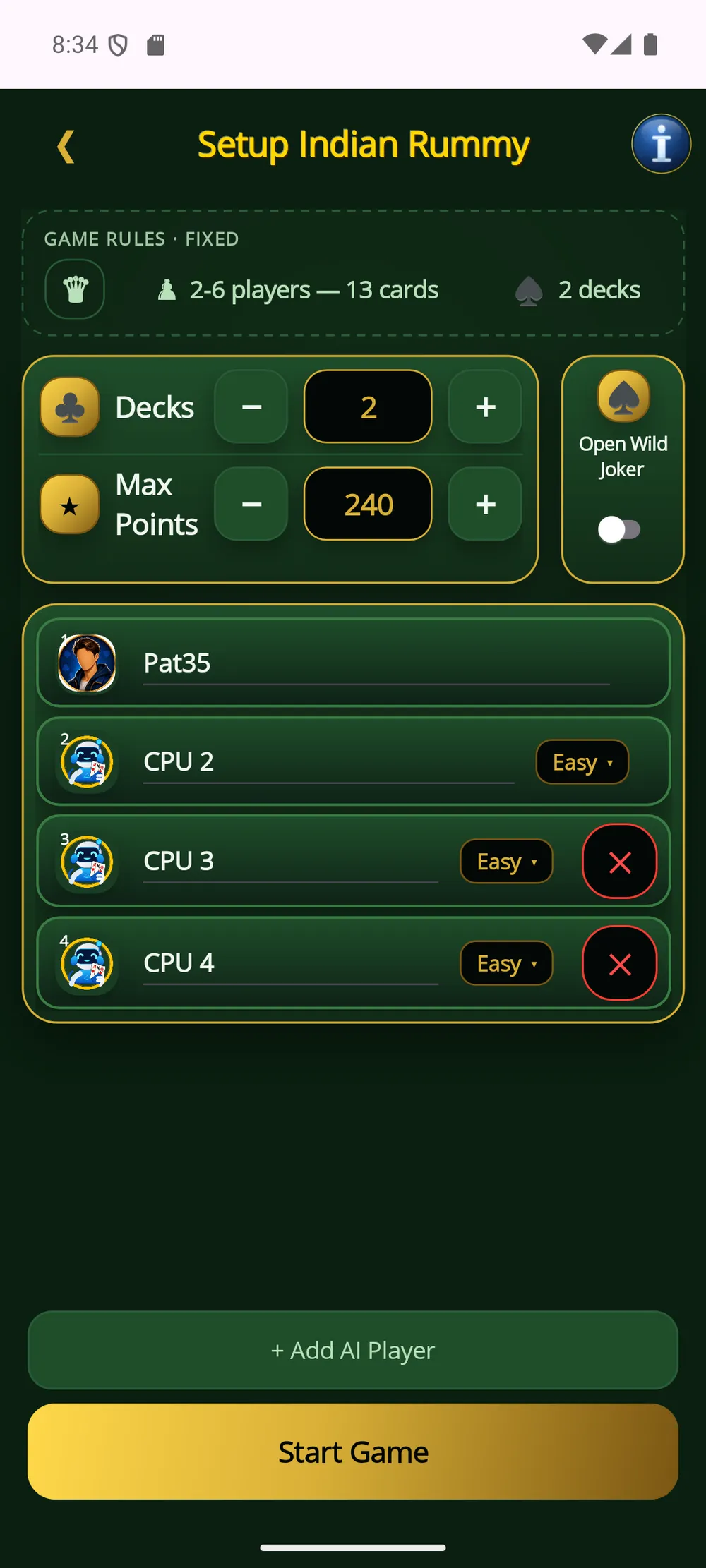
Create your own Indian Rummy table in seconds — choose the seats, share the invite code, and fill empty spots with AI opponents.
Join a Indian Rummy Table by Invite
Enter a friend's invite code and take your seat at their Indian Rummy table — no strangers, just your crew.
Play Indian Rummy Against the Computer
Practice Indian Rummy against smart AI opponents with multiple difficulty levels — the perfect way to learn the game or test new strategies.
Play Indian Rummy Offline
No connection? No problem. Play Indian Rummy offline against computer opponents, anywhere you are.
🎯 Objective
Arrange all 13 cards into valid sequences and sets, with at least one pure sequence, and declare before opponents.
🃏 Indian Rummy Setup & Rules
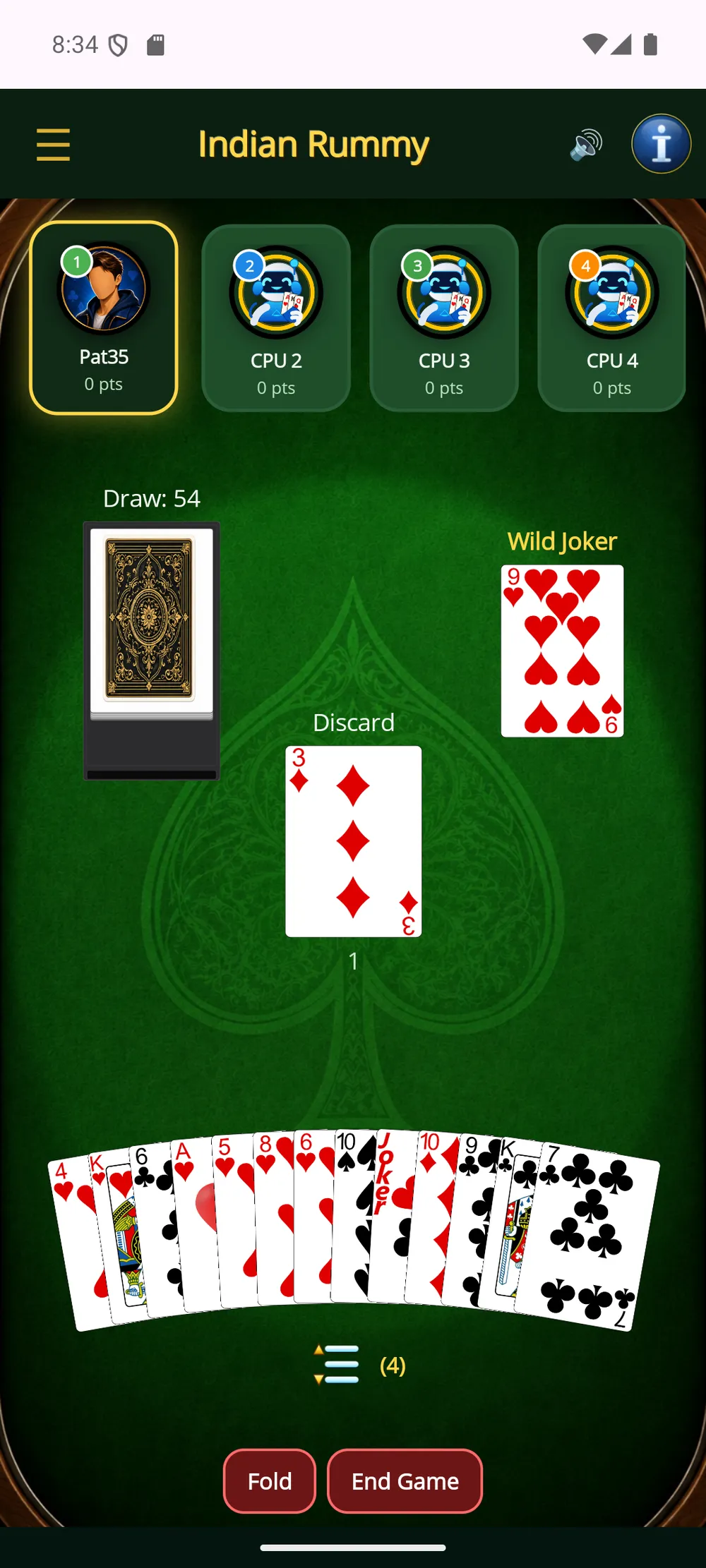
- Uses 2 standard 52-card decks + 2 printed Jokers (108 cards total). Deal 13 cards each.
- Flip one card to start the discard pile. Draw a random card from the remaining deck — its rank is the Wild Joker for this hand.
▶ How to Play Indian Rummy
- Draw one card from the draw pile or top of discard pile.
- Then discard one card.
- Pure Sequence: 3+ consecutive same-suit cards, NO Joker (e.g., 5♥ 6♥ 7♥).
- Impure Sequence: 3+ consecutive same suit with a Wild or Printed Joker substituting.
- Set: 3–4 same-rank cards from different suits (Jokers may be used).
- To declare, place final discard face-down and show your arranged hand.
🎬 Watch: How to Play Indian Rummy
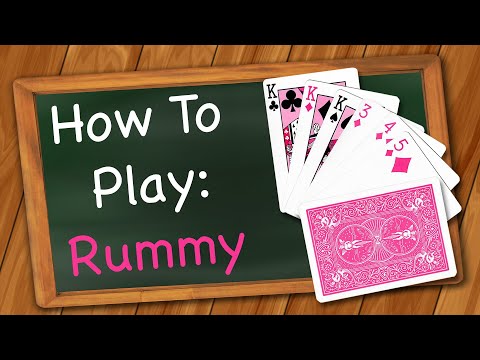
This video is embedded from YouTube and remains the intellectual property of its respective creator and/or rights holder. Vanikar LLC claims no ownership of, or rights in, the video content, and no affiliation with or endorsement by its creator is implied. The video is displayed via YouTube’s public embed feature in accordance with the YouTube Terms of Service and the agreements between YouTube and the content uploader.
📖 Detailed Guide
Setting up your table
- Indian Rummy plays 2–6 using two full decks plus printed jokers (108 cards). Each player receives 13 cards.
- After the deal, one random card is revealed as the WILD JOKER — every card of that rank (in any suit) acts as a joker for the whole hand, alongside the printed jokers.
- One card is flipped to start the discard pile; the rest form the face-down draw pile.
What you're building
- Your goal is to arrange all 13 cards into sequences and sets: at minimum two sequences, one of which must be PURE.
- A PURE sequence is 3+ consecutive cards of the same suit with NO jokers (e.g., 5♥ 6♥ 7♥). Without one, your declaration is invalid no matter how good the rest is.
- An impure sequence uses a wild or printed joker to fill a gap. A set is 3–4 cards of the same rank in different suits (jokers allowed).
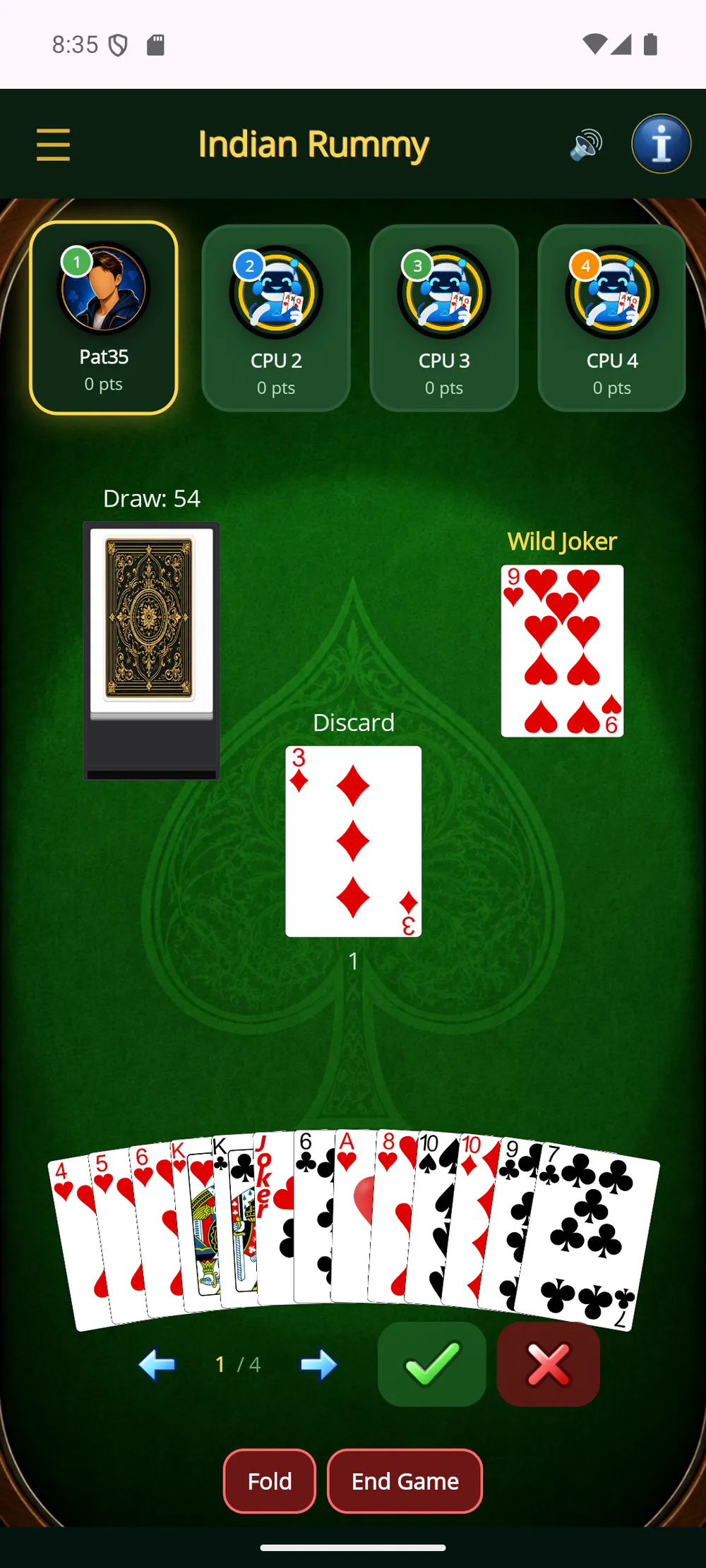
- Use the sort helper to group your hand by suit, then mark out which cards are heading into which meld.
Each turn: draw, plan, discard
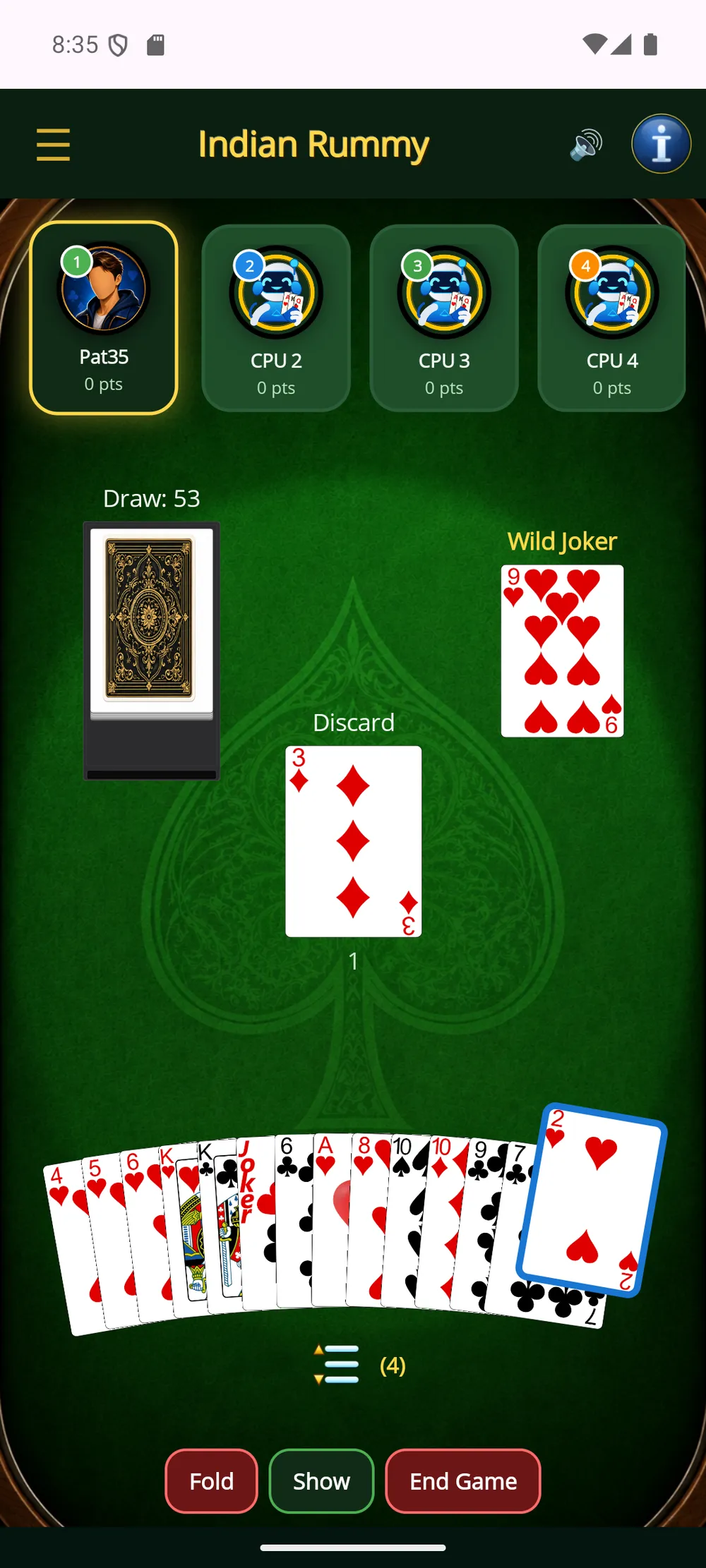
- Draw one card — from the face-down pile (private) or the top of the discard pile (public, and everyone sees what you wanted).
- Re-arrange, then discard exactly one card face-up to end your turn.
- Discard high unattached cards (A, K, Q, J are 10 points each as deadwood) early, and never throw cards adjacent to what an opponent just picked up.
Dropping and declaring
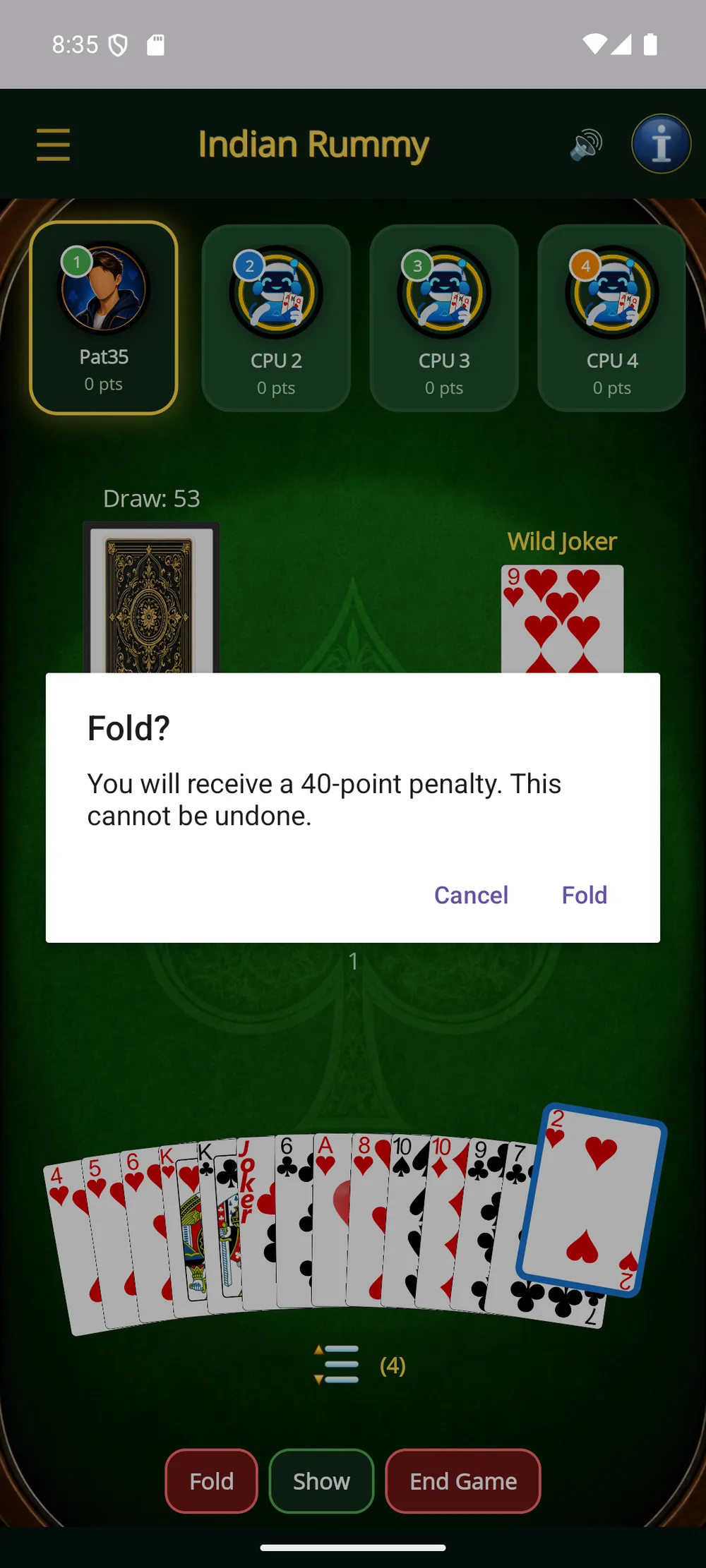
- If your dealt hand is hopeless, you can FOLD (drop) for a fixed penalty — far cheaper than being caught with 60+ points of deadwood. A first-turn drop costs the least.
- To finish, complete your 14th-card turn by discarding face-down to declare, then show your arranged melds.
- A valid declaration (pure sequence + all cards melded) scores zero; opponents score their deadwood, up to the 80-point cap.
- A WRONG declaration is the worst result in the game: an automatic 80-point penalty while opponents drop to zero. Double-check before you declare.
📊 Indian Rummy Scoring
Declarer scores 0 if valid. Deadwood penalty: number cards = face value, J/Q/K/A = 10 pts, Joker = 0. Maximum penalty = 80 pts. Wrong declaration = 80 pt penalty.
❓ Indian Rummy — Frequently Asked Questions
How many players do you need for Indian Rummy?
Indian Rummy is played with 2–6 players. On Vanikar, empty seats can be filled with AI opponents so you can always start a game.
Can I play Indian Rummy against the computer?
Yes — play Indian Rummy against smart AI opponents with multiple difficulty levels. It's the perfect way to learn the game or sharpen your strategy.
Can I play Indian Rummy online with friends?
Yes. Create a private table in the Vanikar app and invite friends and family to play Indian Rummy together online, wherever they are.
Can I play Indian Rummy offline?
Yes — Indian Rummy supports offline play against computer opponents, so you can play without an internet connection.
Is Indian Rummy free to play?
Yes — download the Vanikar Card Games app on iOS or Android and play Indian Rummy free for 2 weeks, no credit card required.
📱 Indian Rummy in the app
A step-by-step look at a real game on the table.