Spiele Indian Rummy online
Bilde Folgen und Sätze — eine reine Folge ist Pflicht.
Indisches Rommé (Paplu bzw. 13-Karten-Rommé) ist Indiens beliebtestes Kartenspiel. Jeder Spieler erhält 13 Karten und muss sie in gültige Folgen und Sätze ordnen. Die goldene Regel: Ohne mindestens eine reine Folge darfst du nicht auslegen.
🎮 So kannst du Indian Rummy spielen
Erstelle einen Indian Rummy-Tisch
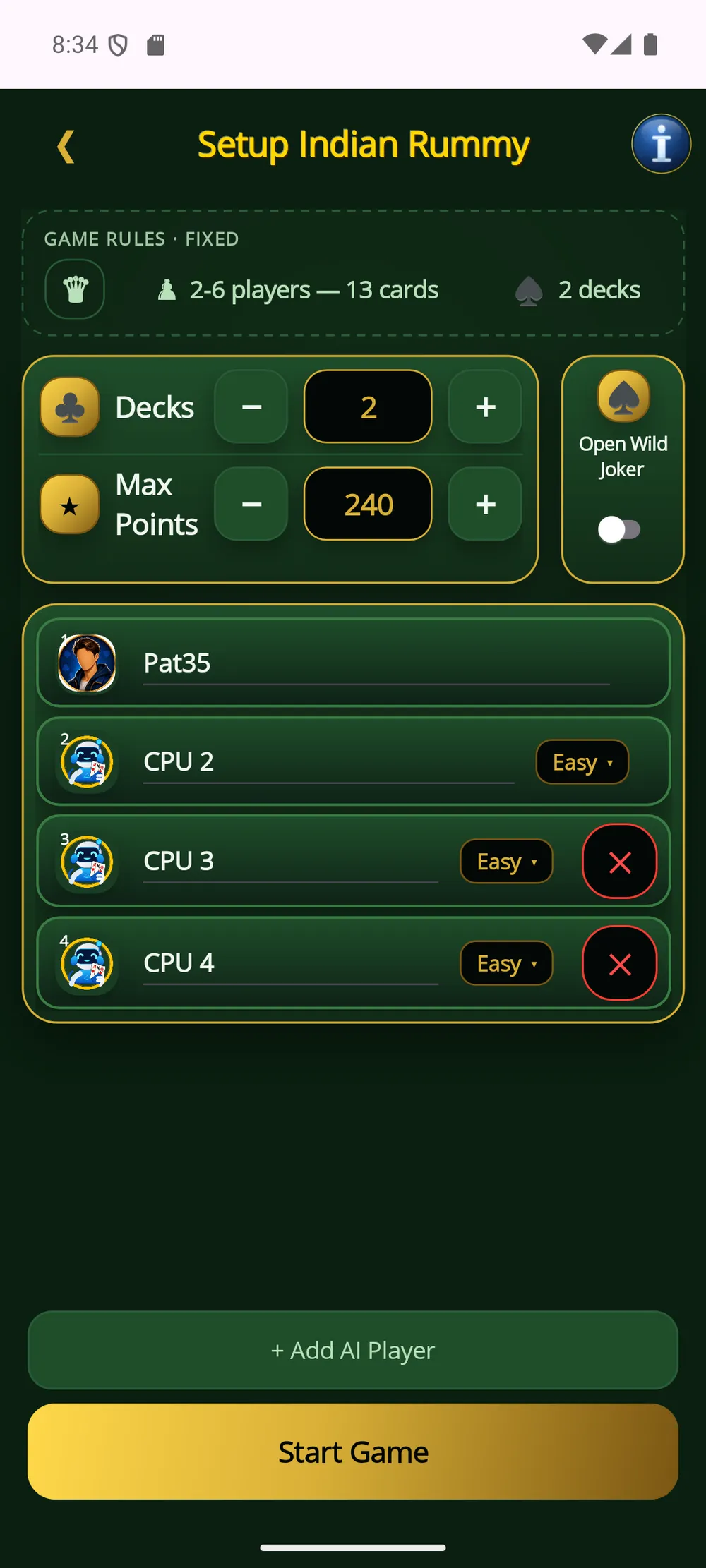
Erstelle in Sekunden deinen eigenen Indian Rummy-Tisch — wähle die Plätze, teile den Einladungscode und fülle leere Plätze mit KI-Gegnern.
Tritt einem Indian Rummy-Tisch per Einladung bei
Gib den Einladungscode eines Freundes ein und nimm an seinem Indian Rummy-Tisch Platz — keine Fremden, nur deine Leute.
Indian Rummy gegen den Computer spielen
Übe Indian Rummy gegen smarte KI-Gegner mit mehreren Schwierigkeitsgraden — perfekt, um das Spiel zu lernen oder neue Strategien zu testen.
Indian Rummy offline spielen
Keine Verbindung? Kein Problem. Spiele Indian Rummy offline gegen Computergegner, wo immer du bist.
🎯 Ziel
Alle 13 Karten in gültige Folgen und Sätze ordnen — mit mindestens einer reinen Folge — und vor den Gegnern auslegen.
🃏 Indian Rummy: Aufbau & Regeln
- Verwendet 2 Standarddecks mit je 52 Karten plus 2 gedruckte Joker (108 Karten insgesamt). Gib jedem 13 Karten.
- Decke eine Karte für den Ablagestapel auf. Ziehe eine zufällige Karte aus dem restlichen Deck — ihr Wert ist der Wild-Joker dieser Hand.
▶ So spielst du Indian Rummy
- Ziehe eine Karte vom Stapel oder die oberste vom Ablagestapel.
- Lege danach eine Karte ab.
- Reine Folge: 3 oder mehr aufeinanderfolgende Karten derselben Farbe OHNE Joker (z. B. 5♥ 6♥ 7♥).
- Unreine Folge: 3 oder mehr aufeinanderfolgende Karten derselben Farbe, bei denen ein Wild- oder gedruckter Joker eine Karte ersetzt.
- Satz: 3 bis 4 Karten desselben Werts in verschiedenen Farben (Joker erlaubt).
- Zum Auslegen legst du die letzte Karte verdeckt ab und zeigst dein geordnetes Blatt.
🎬 Video: So spielst du Indian Rummy
Dieses Video wird von YouTube eingebunden und verbleibt geistiges Eigentum des jeweiligen Urhebers bzw. Rechteinhabers. Vanikar LLC beansprucht keinerlei Eigentum oder Rechte an diesem Inhalt; eine Verbindung zum Urheber oder dessen Befürwortung wird nicht impliziert. Die Anzeige erfolgt über die öffentliche Einbettungsfunktion von YouTube im Einklang mit den Nutzungsbedingungen von YouTube und den Vereinbarungen zwischen YouTube und dem Uploader.
📖 Ausführliche Anleitung
Setting up your table
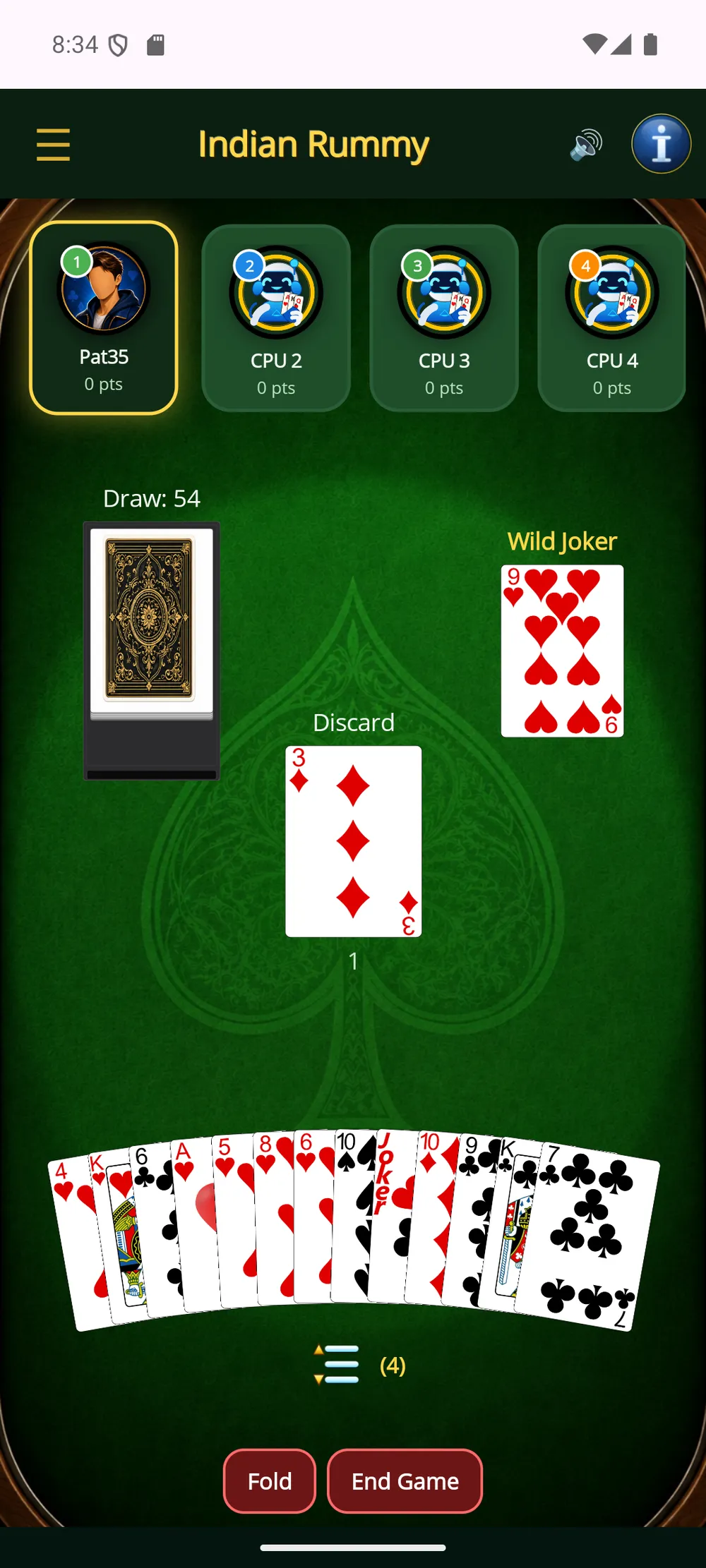
- Indian Rummy plays 2–6 using two full decks plus printed jokers (108 cards). Each player receives 13 cards.
- After the deal, one random card is revealed as the WILD JOKER — every card of that rank (in any suit) acts as a joker for the whole hand, alongside the printed jokers.
- One card is flipped to start the discard pile; the rest form the face-down draw pile.
What you're building
- Your goal is to arrange all 13 cards into sequences and sets: at minimum two sequences, one of which must be PURE.
- A PURE sequence is 3+ consecutive cards of the same suit with NO jokers (e.g., 5♥ 6♥ 7♥). Without one, your declaration is invalid no matter how good the rest is.
- An impure sequence uses a wild or printed joker to fill a gap. A set is 3–4 cards of the same rank in different suits (jokers allowed).
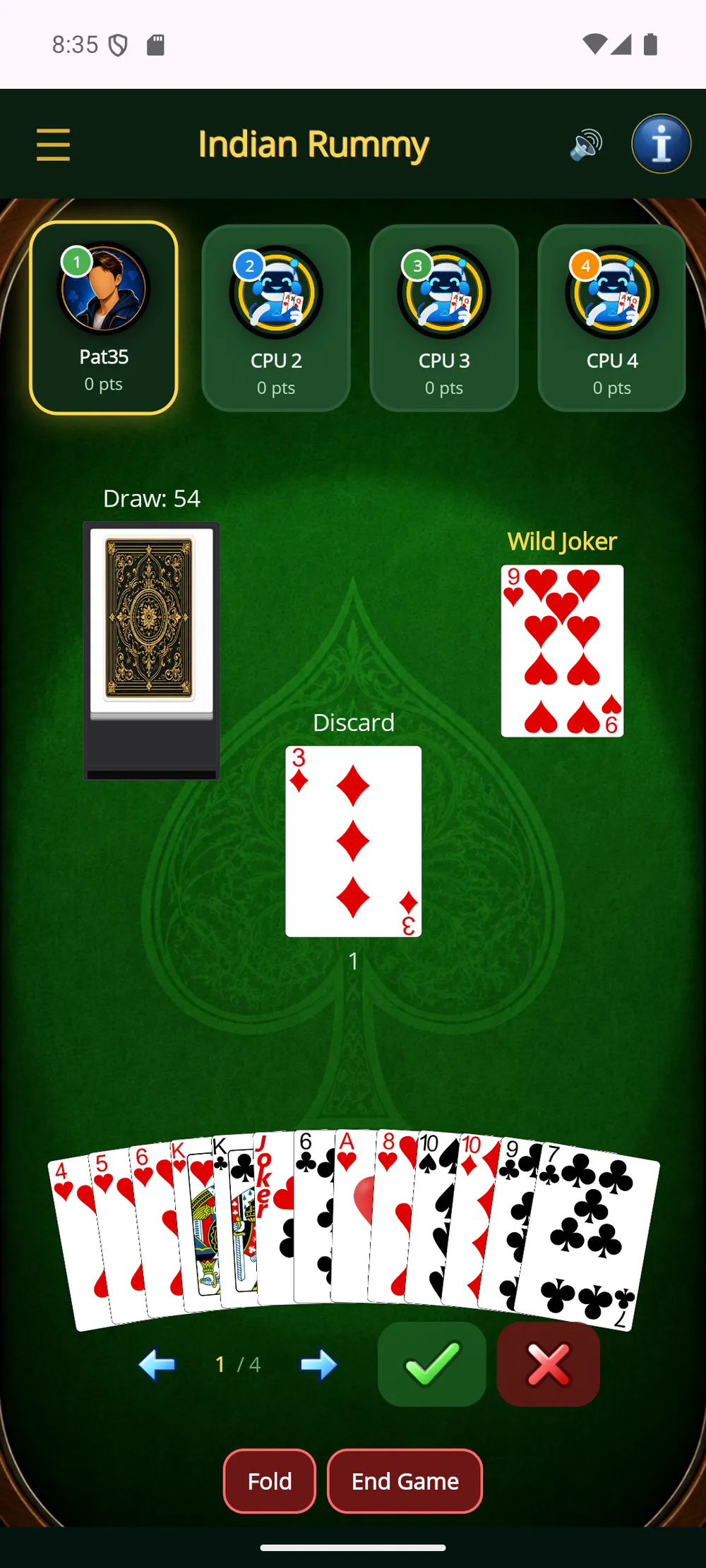
- Use the sort helper to group your hand by suit, then mark out which cards are heading into which meld.
Each turn: draw, plan, discard
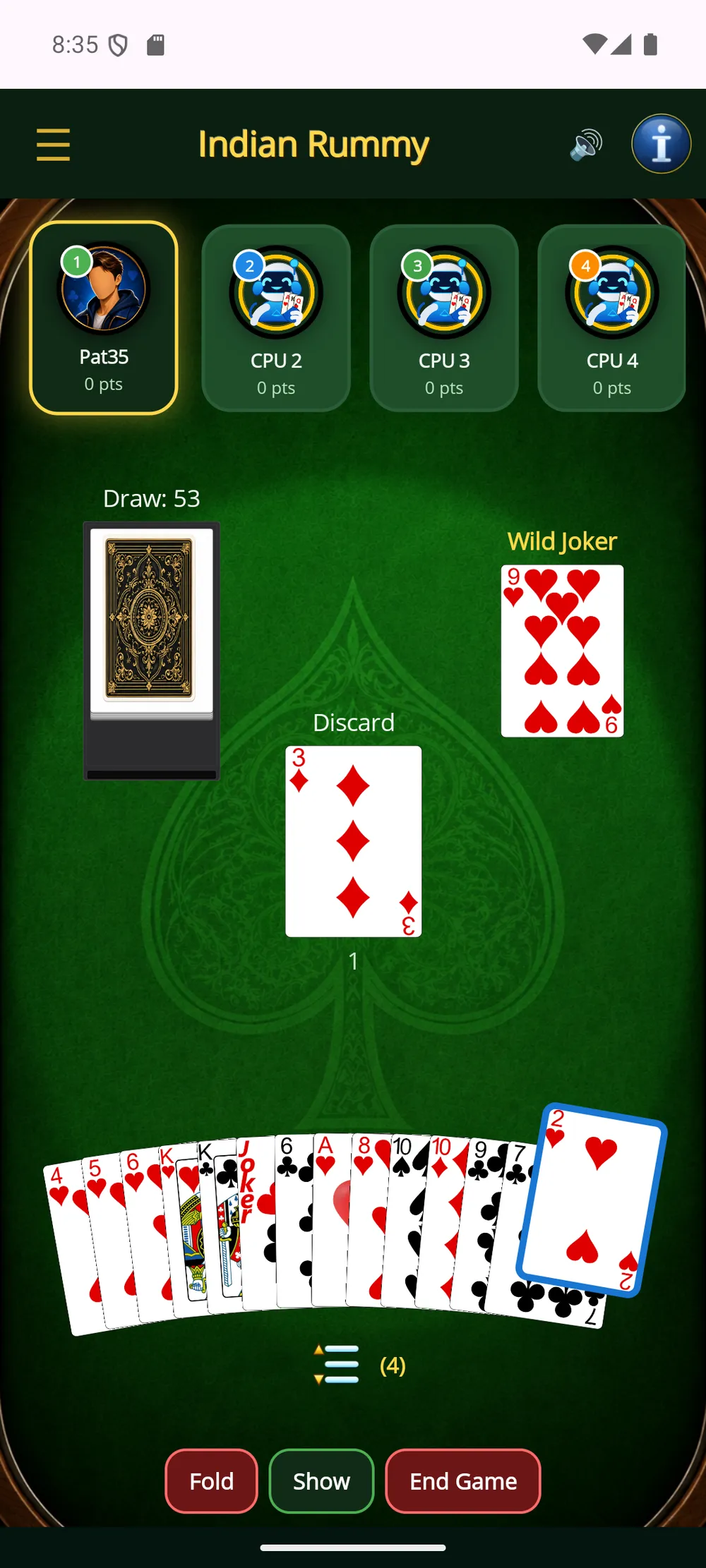
- Draw one card — from the face-down pile (private) or the top of the discard pile (public, and everyone sees what you wanted).
- Re-arrange, then discard exactly one card face-up to end your turn.
- Discard high unattached cards (A, K, Q, J are 10 points each as deadwood) early, and never throw cards adjacent to what an opponent just picked up.
Dropping and declaring
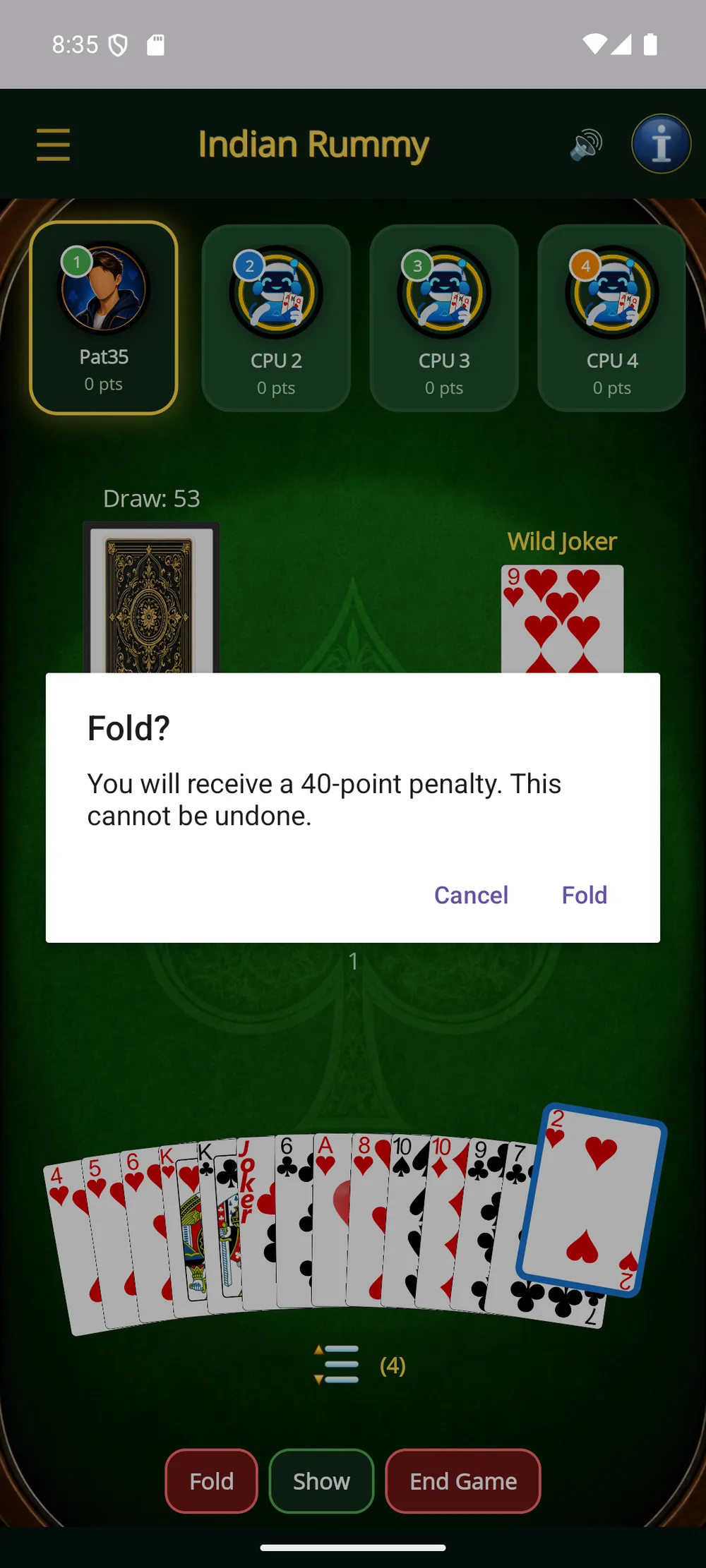
- If your dealt hand is hopeless, you can FOLD (drop) for a fixed penalty — far cheaper than being caught with 60+ points of deadwood. A first-turn drop costs the least.
- To finish, complete your 14th-card turn by discarding face-down to declare, then show your arranged melds.
- A valid declaration (pure sequence + all cards melded) scores zero; opponents score their deadwood, up to the 80-point cap.
- A WRONG declaration is the worst result in the game: an automatic 80-point penalty while opponents drop to zero. Double-check before you declare.
📊 Punktewertung bei Indian Rummy
Ein gültiges Auslegen zählt 0 Punkte. Strafe für lose Karten: Zahlenkarten nach Wert, B/D/K/A je 10 Punkte, Joker 0. Höchststrafe 80 Punkte. Ein ungültiges Auslegen kostet 80 Punkte.
❓ Indian Rummy — Häufige Fragen
Wie viele Spieler braucht man für Indian Rummy?
Indian Rummy wird mit 2–6 Spielern gespielt. Auf Vanikar können leere Plätze mit KI-Gegnern besetzt werden, sodass du jederzeit eine Partie starten kannst.
Kann ich Indian Rummy gegen den Computer spielen?
Ja — spiele Indian Rummy gegen smarte KI-Gegner mit mehreren Schwierigkeitsgraden. Perfekt, um das Spiel zu lernen oder deine Strategie zu schärfen.
Kann ich Indian Rummy online mit Freunden spielen?
Ja. Erstelle in der Vanikar-App einen privaten Tisch und lade Freunde und Familie ein, Indian Rummy gemeinsam online zu spielen — egal, wo sie sind.
Kann ich Indian Rummy offline spielen?
Ja — Indian Rummy unterstützt Offline-Spiel gegen Computergegner, du kannst also auch ohne Internetverbindung spielen.
Ist Indian Rummy kostenlos?
Ja — lade die Card Games App von Vanikar auf iOS oder Android herunter und spiele Indian Rummy 2 Wochen gratis, ohne Kreditkarte.
📱 Indian Rummy in der App
Eine echte Partie am Tisch, Schritt für Schritt.